
As an artist, I often find inspiration in the most unexpected places. Recently, my thoughts drifted back to my childhood and the festive seasons that I enjoyed growing up in a small town with my family. Christmas and New Year were particularly special times, with cultural events and performances that brought the community together. One such event was the appearance of the Masquerades – traditional performers who would dance and entertain households, receiving money in return for their performances and blessings.
As a child, the sight of the Masquerades could be scary, but they were also fascinating and entertaining. Their costumes, masks, and dance steps were all part of a rich cultural tradition that captured my imagination. Whenever we heard or saw them coming, my siblings and I would shout, “Ojuju Calabar dey come ooo!” We even created a song around those words, although I can no longer remember the tune.
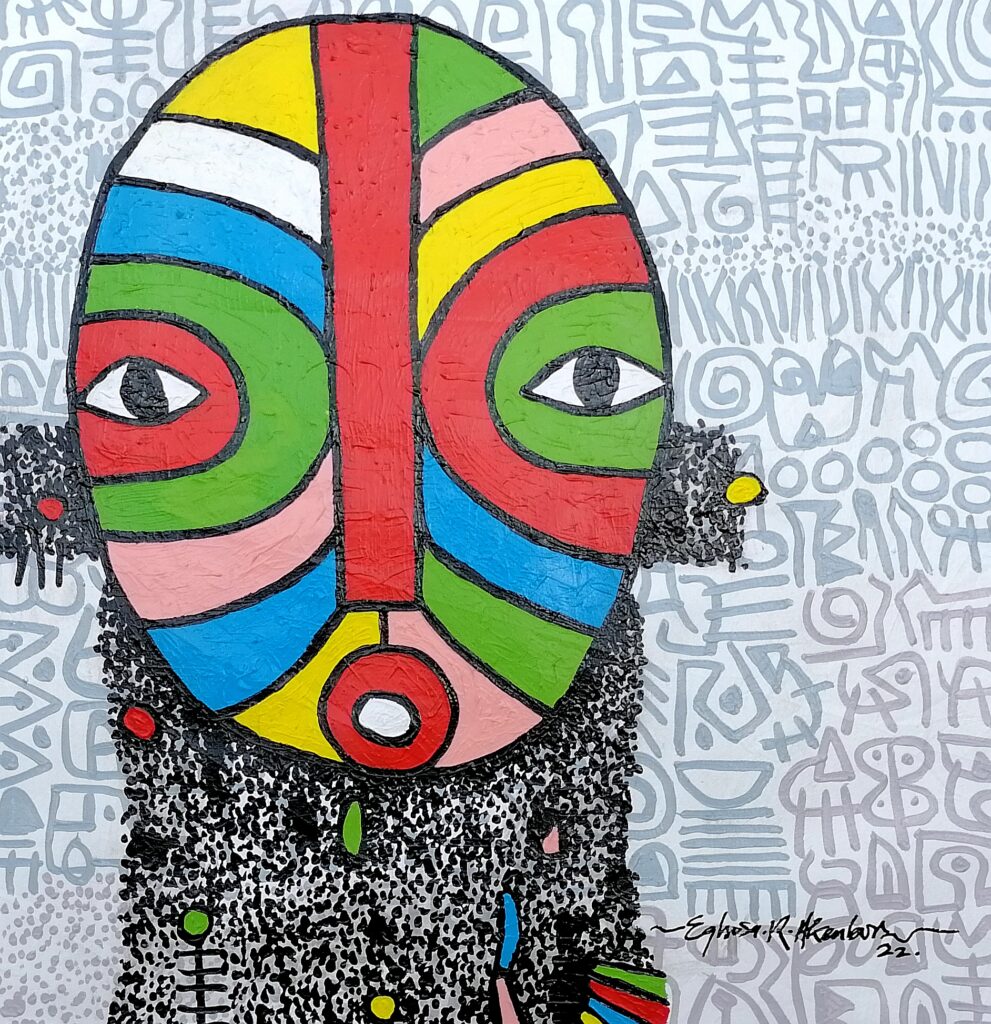
It was these childhood memories that inspired me to create “Ojuju Calabar 2,” an acrylic painting on canvas measuring 29 by 28 inches. The painting features a portrait of a Masquerade against a background of imaginary symbols. The mask’s composition is based on the masks of the Democratic Republic of Congo, known as Kifwebe masks. These masks are incredibly detailed and expressive, crafted into both male and female versions.
In researching these masks, I discovered that they are believed to provide Bwadi Bwa Kifwebe members (a male society) with wealth and supernatural abilities. They are used during the installation and funeral of chiefs, the initiation rites of young boys, and in secret society meetings.
For me, “Ojuju Calabar 2” is a way of connecting with my childhood memories and the rich cultural heritage of my community. It is a celebration of tradition and artistry, and a reminder of the power that cultural performances can hold. I hope that others who view the painting will be inspired to explore their own cultural heritage and the artistic traditions that have shaped their lives.